

Our Projects - ML Classification of Elbow Movements
Machine Learning-Based Classification of Elbow Movements Using Muscle and Kinematics Data for Rehabilitation Applications

I RobertsProject Student
Undergraduate
EMG, IMU, AI, ML
2025
Background
Neurological disorders such as stroke affect billions worldwide, yet access to rehabilitation remains limited by cost, staffing, and availability. The elbow joint is central to daily activities and limb stability, making its rehabilitation particularly important. This project investigates whether affordable EMG and IMU sensors combined with machine learning can accurately classify four elbow movements (flexion, extension, pronation, and supination) to support rehabilitation assessment.
Methods
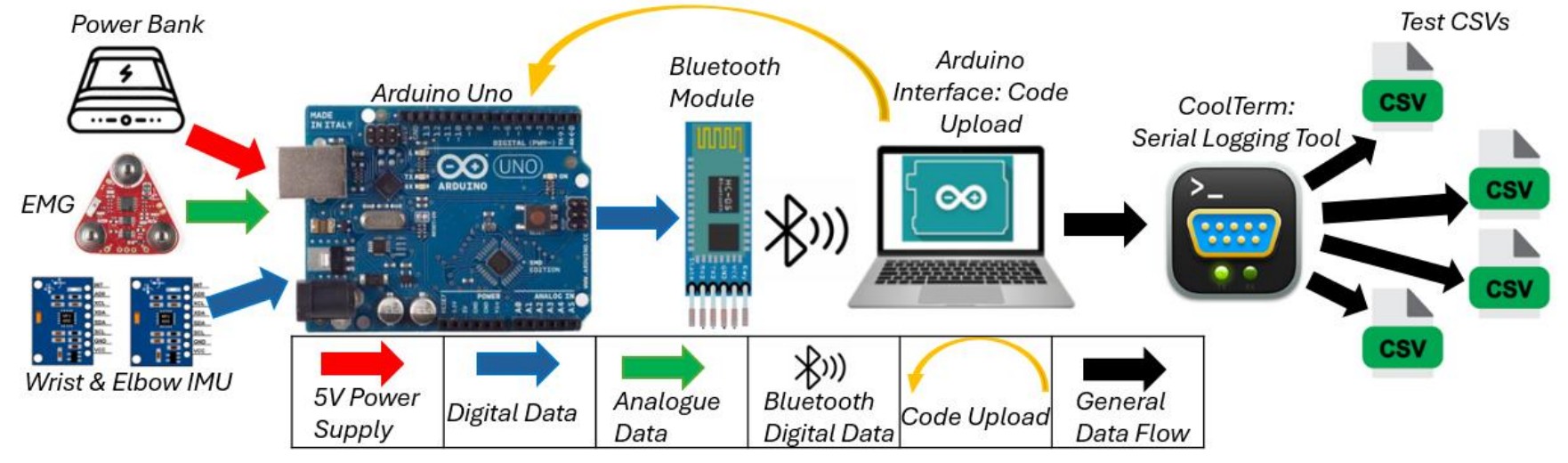
A portable data acquisition circuit was designed using the Systems Engineering V-model, integrating a MyoWare 2.0 EMG sensor and two MPU-6050 IMUs at the wrist and elbow. Data was collected wirelessly at 100 Hz across twenty trials per movement on a single subject. EMG signals were filtered and validated using signal-to-noise ratio analysis, while IMU data was verified through static calibration. Five augmentation techniques expanded the dataset from 20 to 100 samples per class. Three classifiers were trained using an 80:20 split: Naïve Bayes as a baseline, Support Vector Machines, and Random Forest, with hyperparameters optimised via grid search.
Results
EMG and IMU data aligned with expected muscle activation and kinematic trends across all movements. Random Forest achieved the highest test accuracy at 86.51%, followed by SVM at 85.81% and Naïve Bayes at 72.63%. Random Forest also showed the most balanced performance, correctly classifying each movement at least 70% of the time. The most common misclassifications occurred between pronation and supination, reflecting their biomechanical similarity.
Conclusions
This project demonstrates that combining muscle activity and motion data with machine learning is a viable approach for elbow movement classification. Random Forest proved the most effective model, providing a strong foundation for future work including real-time testing, larger participant groups, and potential integration into exoskeleton control systems and gamified rehabilitation programmes.
By combining intelligent control with practical clinical design, RIPPLE seeks to contribute to scalable, patient-centered rehabilitation technologies.