

Our Projects - EEG Controlled Hand-Exoskeleton
EEG-Controlled Robotic Hand Exoskeleton For The Rehabilitation Of Stroke Patients

S AhmedProject Student
Undergraduate
Robotics, AI, EEG
2025
Background
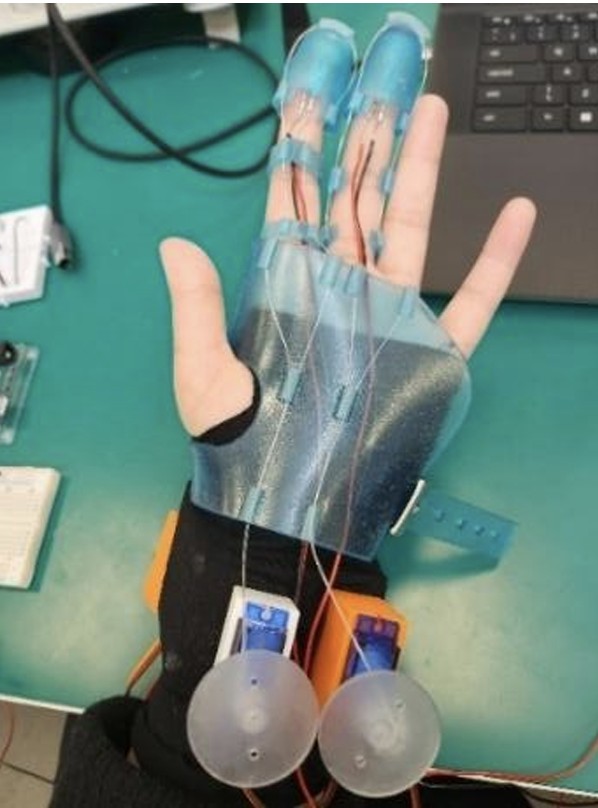
This project demonstrates a prototype brain-computer interface (BCI) system that enables a robotic hand exoskeleton to perform finger movements using interpreted brain signals. The system combines EEG signal processing, machine learning, robotics, and embedded systems to create a low-cost assistive technology designed to support rehabilitation for patients with hand paralysis.
Key Features
The aim of this project was to develop a functional prototype robotic hand exoskeleton controlled by brain signals.
The system translates EEG signals into commands that trigger finger movements through a robotic mechanism.
The goal was to demonstrate a proof-of-concept neurorehabilitation device that is affordable and scalable.
Results
Testing across 10 trials showed:
The system successfully demonstrated proof-of-concept brain-controlled robotic movement, though improvements are needed for real-time operation and increased reliability.
Impact
This project demonstrates the potential of combining machine learning, neuroscience, and robotics to develop assistive technologies for rehabilitation. The prototype provides a foundation for future commercial neurorehabilitation devices.